Ai, Automation, Business Growth, Digital Marketing, Digital Transformation, MiKi Infosys
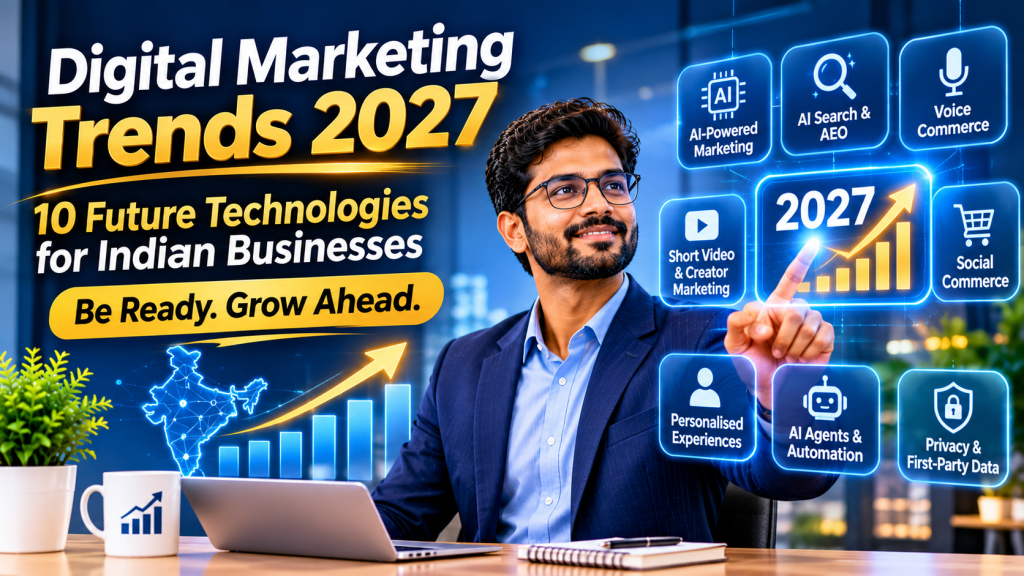
Digital Marketing Trends 2027: 10 New Technologies and Features That Will Transform Business Marketing in India
Nov
AI-powered advertising, intelligent search, voice commerce, personalised marketing and automated customer experiences — how Indian businesses should prepare for the future.
Introduction: What Will Digital Marketing Look Like in 2027?
Digital marketing is entering a new phase.
A few years ago, businesses mainly focused on websites, Google rankings, Facebook advertisements and Instagram followers. Today, artificial intelligence, conversational search, automated customer communication and data-driven advertising are changing how customers discover and purchase products.
By 2027, digital marketing is expected to become more intelligent, personalised and automated.
Imagine a customer in Coimbatore asking an AI assistant:
“I need a reliable website development company near me that can build a website for my textile business.”
Instead of searching through multiple websites, the customer may increasingly expect an AI-powered tool to understand the requirement, compare suitable businesses and help decide what to do next.
Similarly, a customer shopping online may use voice commands, product recommendations or conversational assistants instead of browsing dozens of product pages.
These changes will create new opportunities for Indian businesses, but they will also increase competition.
In this article, MiKi Infosys explores 10 digital marketing trends and emerging features expected to influence 2027, with practical examples for Indian business owners.
Important note: This article combines announced technology developments, industry forecasts and forward-looking predictions. Not every feature described is confirmed for launch in 2027 or guaranteed to be available in India.
1. AI-Powered Marketing Will Become a Business Essential
<text>Expected trend: AI-assisted marketing across more business activities</text>
Artificial intelligence is already helping businesses create content, analyse customer behaviour, prepare advertisements and automate repetitive work.
In 2027, AI is expected to become more deeply integrated into marketing platforms.
Instead of manually managing every marketing activity, business owners may increasingly use AI tools to:
- Analyse advertising performance.
- Identify potential customer segments.
- Suggest campaign improvements.
- Generate creative ideas.
- Prepare social media content.
- Summarise customer enquiries.
- Recommend marketing budgets.
- Automate routine customer follow-ups.
Google has already introduced AI-powered insights, reporting and its Ask Advisor experience across Google Ads and Google Analytics. These developments provide an indication of how marketing management is evolving. https://blog.google/products/ads-commerce/google-ads-analytics-ai-updates/
Example for Indian businesses
Imagine a jewellery shop in Coimbatore.
Its marketing team wants to promote a festive collection.
An AI-assisted workflow could help:
- Analyse previous campaign performance.
- Identify products that attracted interest.
- Suggest customer-focused advertising messages.
- Generate different creative concepts.
- Prepare campaign performance summaries.
The business owner still decides the offer, approves the budget and checks the final advertisements.
What should you do now?
Start using AI for repetitive marketing tasks, but always review important content, pricing and customer communications before publishing.
2. AI Search and Answer Engine Optimisation Will Change SEO
<text>Expected trend: Search visibility beyond traditional Google results</text>
Search engines are evolving from simple lists of links into experiences that can answer questions directly.
Customers may increasingly use AI-powered search tools to research businesses, compare services and understand products.
This creates a new marketing opportunity often called:
- Answer Engine Optimisation (AEO).
- Generative Engine Optimisation (GEO).
- AI Search Optimisation.
These terms describe efforts to make business information useful, accurate and discoverable in AI-powered search and answer experiences.
Example
A customer searches:
“Which digital marketing company can help a small business in Coimbatore generate more enquiries?”
Your business should have useful information explaining:
- Which services you provide.
- Which businesses you support.
- What problems you solve.
- Your working process.
- Your service area.
- Genuine customer experiences.
- How customers can contact you.
How to prepare your website
- Publish helpful articles that answer real questions.
- Use clear headings and structured information.
- Keep business details consistent.
- Create detailed service pages.
- Add genuine customer testimonials.
- Update outdated information.
- Make important pages accessible to search engines.
Important: There is no guaranteed method to force an AI platform to recommend your business. Focus on providing reliable information that both people and search systems can understand.
3. AI Agents May Start Managing More Marketing Activities
<text>Expected trend: From AI assistants to AI agents</text>
One of the most interesting developments for 2027 is the growth of AI agents.
A traditional AI assistant generally helps answer questions or generate content.
An AI agent can be configured to perform a sequence of tasks using connected applications and permissions.
For example, a marketing agent could potentially:
- Check incoming website enquiries.
- Identify the requested service.
- Categorise the enquiry.
- Add the information to a CRM.
- Prepare a suitable response.
- Notify the sales team.
- Schedule a follow-up task.
This can reduce repetitive administrative work.
Indian business example
A real estate company receives enquiries through its website, Facebook and WhatsApp.
An AI-assisted system could classify customers based on their requirements:
- Residential property.
- Commercial property.
- Rental property.
- Property investment.
It could then route each enquiry to the appropriate sales employee.
However, important actions such as sending quotations, making financial commitments or sharing sensitive customer information should have appropriate human approval.
What should business owners do?
Start by automating one repetitive process. Once it works reliably, gradually introduce more advanced AI workflows.
4. Hyper-Personalised Advertising Will Become More Advanced
<text>Expected trend: More relevant advertisements for individual customers</text>
Traditional advertising often targets broad groups based on age, location, interests and behaviour.
With better AI capabilities, businesses may increasingly create advertising experiences that respond to individual customer interests and needs.
For example, an online clothing store may show different product recommendations to customers interested in:
- Office wear.
- Traditional clothing.
- Casual wear.
- Festival collections.
- Wedding collections.
The advertising message, product selection and landing-page experience may adapt to the customer’s preferences.
Example for Indian businesses
A furniture showroom in Chennai could promote:
- Space-saving furniture to customers interested in small apartments.
- Premium furniture to customers researching luxury interiors.
- Office furniture to business customers.
The objective is not to show more advertisements. It is to show more relevant information.
What should businesses prepare?
- Organise product information.
- Maintain accurate customer records.
- Use suitable CRM systems.
- Collect customer data with appropriate permission.
- Segment customers based on legitimate business requirements.
- Avoid excessive or intrusive personalisation.
Privacy and customer consent will be important considerations as India’s data protection framework develops.
5. Voice Search and Regional Language Marketing Will Grow
<text>Expected trend: More conversational interactions in Indian languages</text>
India is a multilingual market.
Many customers are comfortable communicating in Tamil, Hindi, Telugu, Kannada, Malayalam and other regional languages.
Voice-based search and conversational AI can make digital services more accessible to customers who prefer speaking rather than typing.
Consider a customer asking in Tamil:
“கோயம்புத்தூரில் நல்ல வெப்சைட் டெவலப்மெண்ட் கம்பெனி எது?”
Businesses that provide clear regional-language information may have an opportunity to connect with these customers.
What could develop further in 2027?
- Better regional-language AI conversations.
- Voice-based customer support.
- Speech-to-text enquiry processing.
- Multilingual advertisements.
- Regional-language product recommendations.
- Voice-assisted shopping and booking experiences.
These capabilities are developing, and their quality and availability will vary across platforms and languages.
What should Indian businesses do?
- Publish important information in relevant regional languages.
- Create Tamil and English versions of key service pages where useful.
- Prepare regional-language FAQs.
- Use natural language rather than awkward keyword repetition.
- Make customer communication convenient.
Business opportunity: A local business does not need to compete nationally to succeed. It can build stronger relationships by communicating effectively with its local audience.
6. Short Videos and Creator Marketing Will Become More Important
<text>Expected trend: Authentic videos and creator-led storytelling</text>
Customers increasingly want to see real products, actual experiences and genuine demonstrations before purchasing.
Short-form videos, customer testimonials and creator content are likely to remain important parts of digital marketing in 2027.
But simply posting more videos will not guarantee business growth.
Businesses need videos that answer customer questions and demonstrate real value.
Video ideas for Indian businesses
| Business type | Useful video content |
|---|---|
| Textile shop | New arrivals, fabric quality and styling |
| Restaurant | Food preparation, menu highlights and customer experiences |
| Manufacturer | Production process and quality checks |
| Real estate | Property walkthroughs and location information |
| Digital agency | Website demonstrations and business tips |
| Automobile service | Maintenance advice and repair demonstrations |
New opportunities
Businesses may increasingly experiment with:
- AI-assisted video editing.
- Automatic subtitles and translations.
- Virtual product demonstrations.
- Creator collaborations.
- Customer-generated content.
- Interactive video advertisements.
My recommendation: Real videos of your products, people and services can help build credibility. Use AI to improve production, not to replace authenticity.
7. Social Commerce and Conversational Shopping Will Expand
<text>Expected trend: Discover, enquire and purchase through connected digital experiences</text>
Social media is no longer just a place to publish photographs and updates.
It is also an important product discovery and customer communication channel.
Customers may discover products through Instagram Reels, watch demonstrations, ask questions through messaging and complete purchases through an available checkout or website.
In 2027, these connected shopping experiences may become more intelligent.
Example: A clothing business
A customer watches a saree collection video.
The customer wants to know:
- Available colours.
- Fabric details.
- Price.
- Delivery availability.
- Payment options.
An integrated customer journey could provide product information, answer routine questions and guide the customer towards ordering.
Features to watch
- Product catalogues connected to messaging.
- AI-assisted product recommendations.
- Automated order notifications.
- Conversational shopping assistants.
- More connected social advertising and e-commerce experiences.
Availability depends on the platform, region and business eligibility.
What should business owners do?
Keep product information updated, maintain clear pricing and create a smooth process from product discovery to payment.
8. First-Party Data and Customer Privacy Will Become More Important
<text>Expected trend: Responsible data collection and better customer relationships</text>
Businesses should not depend entirely on advertising platforms to understand their customers.
When all customer information remains inside third-party platforms, businesses may have limited control over their customer relationships and reporting.
First-party data refers to information collected directly through your own business interactions, such as:
- Website enquiries.
- Customer registrations.
- Purchase records.
- Newsletter subscriptions.
- Customer service interactions.
- Loyalty programme information.
Example
A Coimbatore-based electronics retailer can maintain an organised customer database containing information customers have agreed to share.
The retailer could use this information to send relevant warranty reminders, service updates and promotional messages where permitted.
What should businesses prepare?
- Maintain a secure customer database.
- Collect only necessary information.
- Explain how customer information will be used.
- Obtain appropriate consent.
- Provide suitable ways to manage communication preferences.
- Restrict employee access.
- Follow applicable Indian data protection requirements.
India’s Digital Personal Data Protection framework makes responsible handling of personal data an important business consideration. Businesses should review applicable rules and obligations rather than assuming that every marketing use of customer data is permitted.
Business lesson: Customer information is valuable, but trust and responsible handling are essential.
9. AI-Powered Advertising and Campaign Management Will Become Smarter
<text>Expected trend: More automation inside advertising platforms</text>
Google and Meta are already integrating AI into their advertising products.
In 2027, advertisers can expect continued development of automated campaign management, creative assistance, targeting and performance analysis.
Google’s AI tools are already helping advertisers understand performance changes, create visual reports and explore campaign insights. https://blog.google/products/ads-commerce/google-ads-analytics-ai-updates/
What may become more common?
- AI-generated advertisement variations.
- Automated creative recommendations.
- Smarter bidding and budget allocation.
- AI-assisted campaign analysis.
- Automated audience insights.
- More conversational campaign management.
Example: A local business advertising campaign
A dental clinic in Coimbatore wants to attract appointment enquiries.
Instead of manually reviewing every campaign metric, its marketing team could use AI-assisted reporting to identify:
- Which advertisements generate enquiries.
- Which locations produce relevant leads.
- Which landing pages perform better.
- Where advertising expenditure is being wasted.
However, automated systems still need accurate conversion tracking, appropriate campaign settings and human supervision.
Important: Automation does not guarantee lower advertising costs or more customers. Measure actual appointments, completed sales and customer acquisition costs.
10. AI Shopping Agents and Agentic Commerce May Change Online Purchasing
<text>Emerging trend: AI systems helping customers make purchase decisions</text>
One of the more advanced developments to watch is agentic commerce.
An AI shopping agent may eventually help a customer:
- Understand a purchase requirement.
- Compare suitable products.
- Check prices and features.
- Identify available sellers.
- Assist with ordering through supported services.
For example, a customer might ask an AI assistant:
“Find a suitable office chair under ₹8,000 with good back support and delivery to Coimbatore.”
An AI-powered shopping experience could help compare available options and guide the customer towards a purchase.
Industry forecasts suggest that conversational shopping and autonomous purchasing could become more important, but widespread adoption in India, payment integrations and merchant availability are not guaranteed for 2027. https://www.forrester.com/press-newsroom/forresters-2027-b2c-marketing-cx-and-digital-predictions-rising-ai-costs-will-force-b2c-leaders-to-scale-back-a-third-of-ai-initiatives/
How can businesses prepare?
- Maintain accurate product descriptions.
- Publish clear specifications.
- Keep prices and stock availability updated.
- Provide reliable delivery and return information.
- Make product data easy to understand.
- Maintain secure and reliable payment processes.
Business lesson: Your product information should be useful not only to human customers but also to the digital systems helping customers compare products.
11. What Will Digital Marketing Cost in 2027?
Digital marketing costs will continue to depend on industry, location, competition, platform, campaign objective and the quality of the advertising strategy.
AI tools may reduce some manual work, but they can also introduce subscription, usage and integration costs.
Forrester’s 2027 predictions highlight that rising AI costs may force businesses to reconsider initiatives that do not produce measurable value. Its research also emphasises the renewed importance of human-created content and customer trust. https://www.forrester.com/press-newsroom/forresters-2027-b2c-marketing-cx-and-digital-predictions-rising-ai-costs-will-force-b2c-leaders-to-scale-back-a-third-of-ai-initiatives/
This is an important lesson for small businesses.
Do not purchase every new AI subscription simply because it is trending.
Before investing, ask:
- Does this tool solve a real problem?
- Will it save time or improve results?
- Does it integrate with my existing systems?
- Are there ongoing usage charges?
- Can my employees operate it?
- How will I measure its value?
The smartest marketing investment is not necessarily the most expensive technology. It is the one that delivers measurable business results.
12. A Practical 2027 Digital Marketing Preparation Plan for Indian Businesses
You do not need to implement all these technologies immediately.
Start with a practical preparation plan.
Phase 1: Strengthen Your Digital Foundation
- Build or improve your business website.
- Make your website mobile-friendly.
- Update your Google Business Profile.
- Publish useful service and product information.
- Collect genuine customer reviews.
- Improve website speed and security.
Phase 2: Prepare for AI Search
- Publish articles answering customer questions.
- Create detailed service pages.
- Add relevant FAQs.
- Keep business details consistent.
- Publish original photographs and examples.
- Update outdated website content.
Phase 3: Introduce AI and Automation
- Use AI to prepare content drafts.
- Automate enquiry recording.
- Create follow-up reminders.
- Prepare automated marketing reports.
- Explore AI-assisted customer support.
- Keep human approval for important actions.
Phase 4: Improve Advertising and Measurement
- Review Google Ads and Meta Ads.
- Test different creative formats.
- Track qualified enquiries.
- Measure customer acquisition costs.
- Compare advertising spend with actual sales.
- Stop campaigns that are not producing useful results.
Phase 5: Build Long-Term Customer Relationships
- Maintain customer records responsibly.
- Improve after-sales support.
- Send relevant updates with appropriate consent.
- Create useful educational content.
- Encourage genuine customer feedback.
- Focus on repeat business and referrals.
13. Five Skills Business Owners Should Develop Before 2027
Technology alone will not make a business successful. Business owners also need to understand how to use it.
Here are five valuable skills:
- AI literacy: Understand what AI can do, where it can fail and how to supervise it.
- Digital marketing knowledge: Understand SEO, advertising, social media and customer journeys.
- Data analysis: Learn to interpret enquiries, sales, costs and campaign performance.
- Customer experience: Understand what makes customers trust and choose your business.
- Digital security: Protect business accounts, customer data and online assets.
You do not need to become a technical expert. You need enough knowledge to make informed business decisions.
Conclusion: 2027 Will Reward Businesses That Combine Technology With Trust
Digital marketing in 2027 is expected to be more intelligent, personalised, conversational and automated.
AI-powered search may influence how customers discover businesses. AI agents may help manage marketing tasks. Voice and regional-language experiences may become more useful. Social commerce, creator marketing and personalised advertising may create new opportunities.
But one thing will remain important: customers will continue to choose businesses they trust.
A professional website, accurate information, genuine customer reviews, useful content and reliable service will remain essential.
Do not wait until every new technology becomes mainstream.
Start preparing today by improving your digital foundation, understanding your customers and adopting technology where it creates real business value.
The future of digital marketing is not about using the maximum number of AI tools. It is about using the right technology to build stronger customer relationships and better business results.
How MiKi Infosys Can Help Your Business Prepare for 2027
MiKi Infosys helps businesses strengthen their digital presence with practical technology and marketing solutions.
Our services include:
- Professional Website Development.
- Search Engine Optimisation (SEO).
- Digital Marketing and Google Ads.
- Social Media Management.
- Google Business Profile Management.
- Branding and Graphic Design.
- AI-Powered Workflow Planning.
- Business Automation Solutions.
- MiKi DiGi Digital Business Cards.
Whether you run a retail shop, manufacturing unit, service company or growing online business, the right digital strategy can help you prepare for the next stage of business growth.
MiKi Infosys — Your Business. Digitally Better.
Website: https://www.mikiinfosys.xyz
