
Ai, Digital Marketing, MiKi Infosys
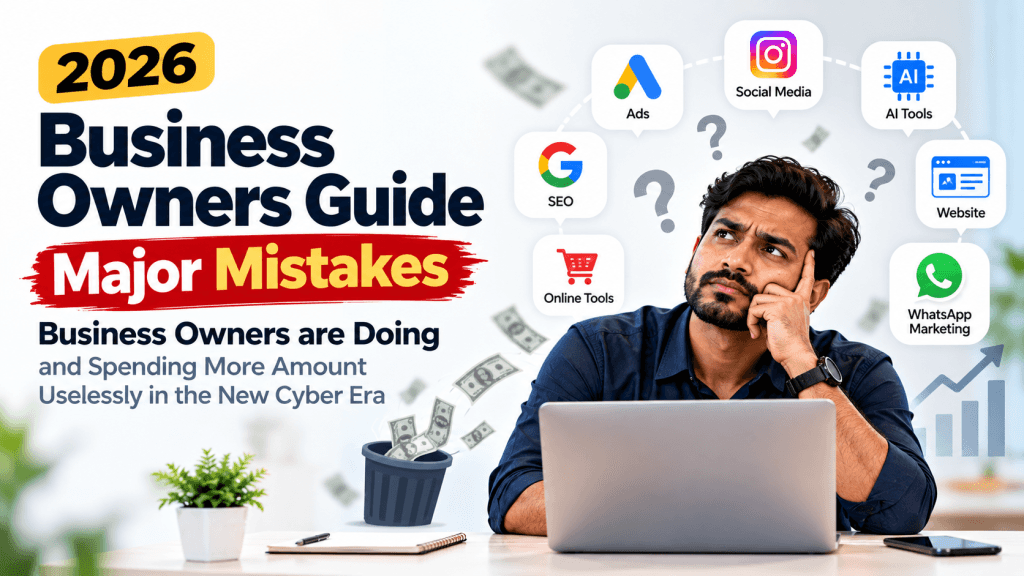
2026 Business Owners Guide: 10 Digital Mistakes That Waste Your Money — And How to Avoid Them
Oct
Every business owner wants the same thing: more customers, better sales, stronger brand recognition and sustainable growth.
But in 2026, the business environment is changing rapidly. Customers discover businesses through Google Search, social media, online reviews, websites, WhatsApp and AI-powered tools. Competitors are adopting new technologies, advertising platforms are becoming more automated, and customer expectations are increasing.
In this environment, many business owners spend thousands of rupees every month on digital marketing, website development, software subscriptions and online promotions—without knowing whether that spending is actually helping their business.
Some invest in followers instead of customers. Others run advertisements without a clear strategy. Some purchase expensive software they barely use, while others ignore the basic digital systems that could bring them genuine enquiries.
The biggest problem is not always a lack of budget. It is spending money without a clear business objective, proper measurement or a plan to improve results.
This guide explains the major mistakes business owners make in the digital era, why they waste money, and what you can do to overcome them.
1. Spending on Digital Marketing Without a Clear Goal
The mistake: Paying for activity instead of business results.
Many business owners start digital marketing by saying:
-
“I want more followers.”
-
“I want more views.”
-
“I want to become famous on Instagram.”
-
“My competitor is advertising, so I should advertise too.”
These goals may have value, but they don’t automatically generate revenue.
Before spending money, decide what you actually want to achieve.
| Business goal | What you should measure |
|---|---|
| Increase brand awareness | Reach and relevant audience engagement |
| Generate enquiries | Qualified leads and cost per lead |
| Increase sales | Orders, conversions and revenue |
| Get local customers | Calls, directions and genuine enquiries |
| Grow an online store | Purchases and customer acquisition cost |
Google Ads provides conversion tracking to help businesses understand which campaigns lead to valuable actions, such as purchases, sign-ups and calls.

How to overcome it: Write down one primary business objective before launching each campaign. Choose your budget, target audience and performance measures around that objective.
2. Believing Every Marketing Agency That Promises Guaranteed Results
The mistake: Choosing a service based on promises rather than evidence.
Imagine an agency promises:
-
10,000 followers for a fixed amount.
-
One lakh views every month.
-
Hundreds of leads within a few days.
-
Guaranteed sales from every advertisement.
These promises may sound attractive, but business owners should ask how the results will be achieved and whether they are relevant to their business.
No responsible marketer can guarantee every outcome across every campaign, audience and industry.
How to overcome it:
Before hiring an agency, ask for:
-
A clear scope of work.
-
Relevant previous campaign examples.
-
A realistic marketing plan.
-
Transparent reporting.
-
Defined deliverables and performance indicators.
-
Clear terms covering ad spend and agency fees.
Remember that a promise is not proof of performance.
3. Spending on Followers Instead of Potential Customers
The mistake: Confusing popularity with profitability.
A business page may have thousands of followers but very few enquiries. Another business may have a smaller audience but attract more relevant customers.
For example, a local service provider in Coimbatore may benefit more from reaching people who need that service locally than from collecting followers across unrelated locations.
Fake followers and low-quality engagement can also distort performance reports.
How to overcome it:
-
Focus on your ideal customer profile.
-
Target relevant locations.
-
Publish content that addresses customer problems.
-
Make your phone, website and WhatsApp contact options easy to find.
-
Measure qualified enquiries and sales, not just follower growth.
4. Running Paid Advertisements Without Tracking Results
The mistake: Spending money without knowing what it produces.
Suppose your business spends ₹15,000 on advertisements every month.
At the end of the month, you know that the ads received views and clicks—but you don’t know how many enquiries became customers.
How can you decide whether to increase or reduce your budget?
You can’t make a sound decision without the right information.
A simple example
Illustrative monthly campaign
Advertising spend
₹15,000
Enquiries received
75
Cost per enquiry
₹200
Customers acquired
10
Advertising cost per acquired customer
₹1,500
These are hypothetical figures for explanation, not a promise of campaign performance. Agency fees, other sales costs and profit are excluded.
Now the business owner can ask whether those ten customers generated enough profit to justify the advertising and other costs.
How to overcome it: Set up conversion tracking, maintain an enquiry register and review which campaigns generate actual customers. Google explains how conversion measurement can help businesses evaluate advertising performance and make better spending decisions.
5. Buying Expensive Software That Nobody Uses
The mistake: Purchasing technology before identifying the problem.
In the new cyber era, businesses are constantly introduced to AI tools, CRM platforms, automation software, premium design applications, email marketing systems and subscription services.
Some are valuable. Others may be unnecessary for your current business needs.
A business owner might pay for several monthly subscriptions while the team continues managing enquiries manually.
How to overcome it:
Before buying any tool, ask:
-
What specific problem will it solve?
-
How many hours will it save?
-
Will it help generate revenue or reduce costs?
-
Does an existing tool already provide this feature?
-
Will employees actually use it?
-
Can we test it before committing to a long-term plan?
Start with one practical tool, measure its value and expand only when necessary.
6. Using AI Without a Business Strategy
The mistake: Adopting AI because it is trending.
AI can help with content creation, research, customer support, data analysis and repetitive administrative tasks.
But installing an AI tool doesn’t automatically improve a business.
For example, generating 100 social media posts with AI is not useful if those posts are irrelevant to your customers or contain inaccurate information.
Likewise, automating customer replies without reviewing their quality can damage trust.
How to overcome it:
-
Identify a repetitive task that consumes time.
-
Test AI on that specific task.
-
Review accuracy and output quality.
-
Protect confidential business and customer information.
-
Keep human approval for sensitive or high-impact actions.
-
Measure time saved and business value.
Use AI to improve your workflow—not simply to follow a trend.
7. Ignoring Website Quality and Mobile Experience
The mistake: Paying to attract visitors to a website that fails to convert them.
Imagine a customer clicks your advertisement but encounters:
-
A slow-loading website.
-
Confusing service descriptions.
-
Outdated contact information.
-
No clear pricing guidance.
-
A difficult enquiry form.
-
A website that works poorly on mobile.
The advertising may bring visitors, but the website can prevent them from becoming customers.
How to overcome it:
Your website should clearly communicate:
-
What your business offers.
-
Who your services are for.
-
Why customers should trust you.
-
What makes your business different.
-
How to enquire or purchase.
Test the website on mobile devices, check loading performance, update important information and make the next step obvious.
Important: Don’t keep increasing your advertising budget until you have checked whether your website is doing its job.
8. Depending on Only One Platform
The mistake: Building your entire digital presence on rented space.
Some businesses depend entirely on Instagram, Facebook or a marketplace.
But platform policies, reach, advertising costs and account access can change. If your business depends on a single platform, a disruption can affect customer acquisition.
How to overcome it:
Build a connected digital presence:
-
Website: Your main online information hub.
-
Google Business Profile: Local discovery and business information.
-
Social media: Brand awareness and customer engagement.
-
WhatsApp or email: Customer communication and follow-up.
-
Customer records: Organised information collected and managed appropriately.
Keep control of your domain, business accounts and customer data. Give staff and agencies appropriate access rather than sharing one password with everyone.
9. Ignoring Cybersecurity to Save Money
The mistake: Treating security as an optional expense.
Many businesses spend money on advertising and software but overlook basic security.
A compromised email account, website, social media page or advertising account can disrupt operations and expose sensitive information.
Cybersecurity isn’t only for large corporations. The US Federal Trade Commission’s small-business guidance recommends practical measures such as strong unique passwords, multi-factor authentication, software updates, regular backups and staff training.
How to overcome it:
-
Enable multi-factor authentication wherever available.
-
Use unique, strong passwords and a password manager.
-
Keep websites, plugins, devices and software updated.
-
Back up important files and test recovery.
-
Restrict access to sensitive systems.
-
Verify unexpected payment requests and login links.
-
Review access when an employee or agency relationship ends.
Avoiding unnecessary security spending is sensible; ignoring essential security is not.
10. Failing to Follow Up With Enquiries
The mistake: Spending money to generate leads and then losing them.
A customer enquires through WhatsApp, a website form or a phone call.
But nobody responds promptly. The quotation is delayed. The next follow-up never happens.
The customer eventually chooses a competitor.
In this situation, the marketing campaign may have done its job. The business’s sales process failed.
How to overcome it:
Create a simple lead management process:
-
Record every enquiry.
-
Respond promptly during business hours.
-
Understand the customer’s requirement.
-
Send a clear quotation.
-
Schedule appropriate follow-ups.
-
Record the outcome.
-
Review why enquiries were won or lost.
Even a simple spreadsheet can help a small business organise leads before investing in expensive CRM software.
11. Copying Competitors Instead of Understanding Your Own Customers
The mistake: Spending money on trends that don’t fit your business.
A competitor launches a flashy campaign, so you copy the same design.
Another competitor uses influencers, so you hire an influencer.
Someone else invests in video advertisements, so you do the same.
But your customers, pricing, location, business model and profit margins may be completely different.
How to overcome it:
Study competitors to understand the market, but make decisions based on your own customers.
Ask existing customers:
-
How did you find us?
-
Why did you choose us?
-
What nearly stopped you from buying?
-
What would improve our service?
Use those answers to improve your marketing message and customer experience.
12. Never Reviewing Monthly Expenses
The mistake: Allowing small recurring costs to become a large financial burden.
A business may be paying for:
-
Unused software subscriptions.
-
Duplicate marketing tools.
-
Unnecessary premium plans.
-
Advertising campaigns that are no longer effective.
-
Website services that overlap.
-
Agency services with unclear deliverables.
Individually, these expenses may appear small. Together, they can consume a meaningful part of the monthly budget.
How to overcome it: Conduct a monthly digital expense audit.
Monthly Digital Expense Audit
Use this checklist to review your business’s digital spending.
Advertising
Campaign spend and measurable outcomes
Agency services
Deliverables, reports and strategy
Software subscriptions
Usage, overlap and renewal dates
Website and hosting
Performance, security and actual requirements
AI tools
Usage, accuracy and time saved
Cybersecurity
Backups, access controls and protection
0 of 6 reviewed
Copy checklist
For every expense, ask: Should we keep it, improve it, downgrade it or cancel it?
Don’t cut essential services simply because they don’t generate immediate revenue. Evaluate their purpose, risk reduction and long-term value first.
A Practical 30-Day Plan to Stop Wasting Money
You don’t need to change everything at once. Start with a focused review.
Week 1: Audit
Review marketing expenses, subscriptions, websites, ad accounts and customer enquiry records. Identify spending with unclear value.
Week 2: Set goals
Choose one or two measurable business objectives. Establish a baseline for enquiries, sales, costs and conversion rates.
Week 3: Fix the basics
Improve your website, contact process, lead follow-up, account security and conversion tracking.
Week 4: Measure and improve
Review the data, identify what is working, adjust underperforming activities and plan the next month.
How Should a Business Owner Think in the Cyber Era of 2026?
The most successful digital strategy isn’t necessarily the one with the biggest budget or the newest technology.
It’s the one that connects technology spending to a real business need.
Before approving any new expense, ask these five questions:
-
Purpose: What business problem are we solving?
-
Customer: How will this help our target customers?
-
Measurement: How will we know whether it worked?
-
Cost: What is the total cost, including ongoing fees and staff time?
-
Risk: What security, privacy or operational risks does it introduce?
If you cannot answer these questions, pause and gather more information before committing significant money.
Final Thoughts: Spend Smarter, Not Just More
In 2026, business owners have access to more digital tools than ever before. That creates opportunities, but it also makes it easier to spend money on activities that look impressive without delivering meaningful business value.
You don’t need every new AI tool. You don’t need to be present on every platform. You don’t need the biggest advertising budget.
You need a clear strategy, the right technology, a strong customer experience, secure systems and a habit of measuring results.
Remember this simple principle:
Every digital expense should have a purpose. Every marketing campaign should have a measurable objective. Every technology investment should solve a real problem.
Your goal is not to spend less at any cost. Your goal is to reduce waste, protect your business, improve efficiency and invest more confidently in what works.
MiKi Infosys — Your Business. Digitally Better.
At MiKi Infosys, we believe digital growth starts with the right strategy—not unnecessary spending.
We help businesses build and improve their digital presence through:
-
Website Development
-
Digital Marketing and Social Media Management
-
Google Business Profile
-
Graphic Design and Branding
-
MiKi DiGi Digital Business Solutions
-
AI and Automation Solutions
Build. Promote. Grow. Digitally.
🌐 Website: www.mikiinfosys.xyz 📞 Phone: 93603 71001 📍 Singanallur, Coimbatore, Tamil Nadu
